

Getting more visitors to your website is important, but website traffic alone doesn’t grow a business. What matters is attracting potential customers who are interested in your services and turning those visits into phone calls, quote requests, appointments, and sales.
For small businesses, two of the most effective ways to attract customers through Google are search engine optimization (SEO) and Google Ads.
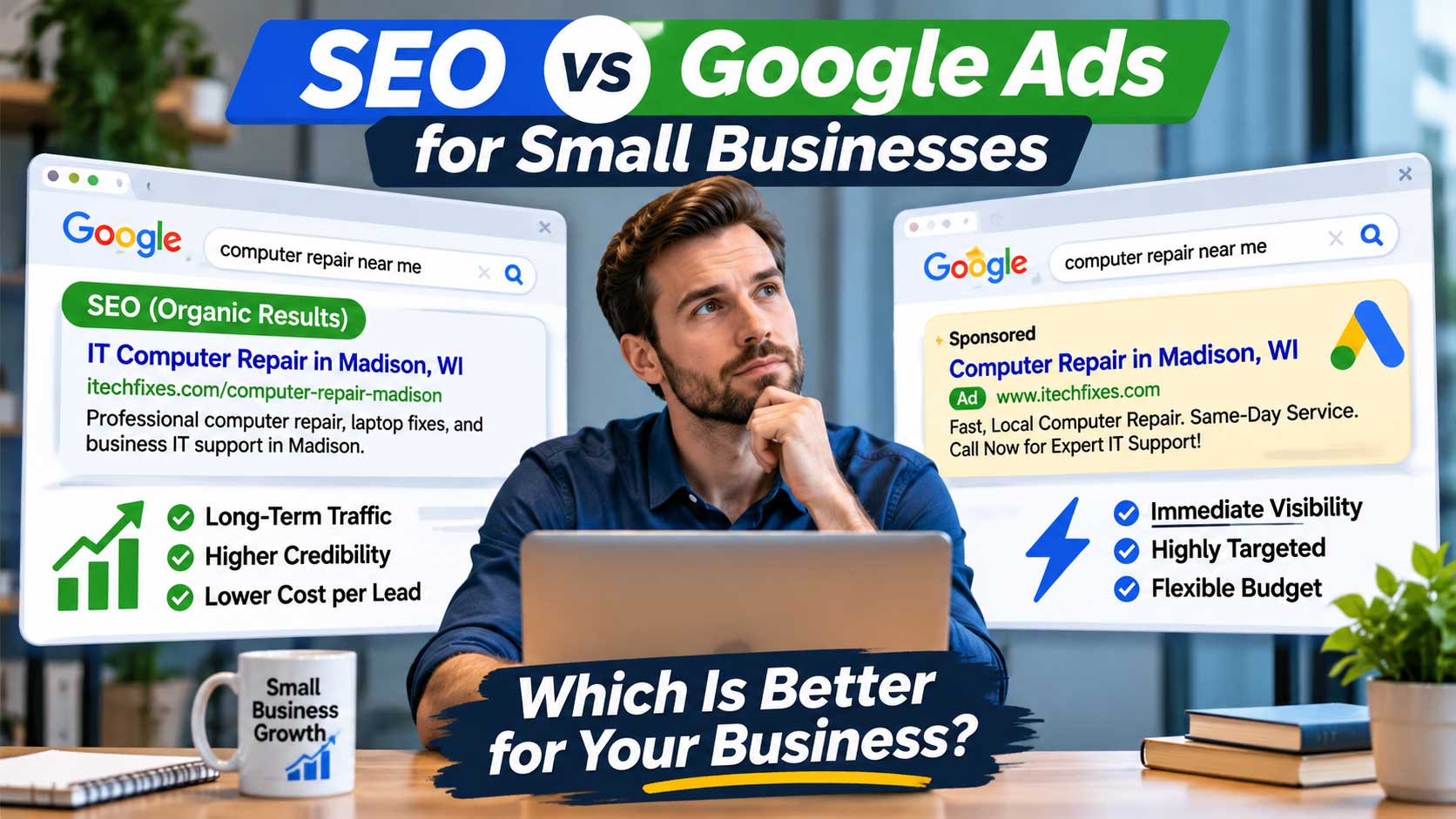
SEO helps your website appear in organic search results when people search for services like yours. Google Ads allows you to reach potential customers more quickly through paid search advertisements.
But which strategy should your business invest in first?
The answer depends on several factors:
- Your timeline: How quickly do you need new customers?
- Your budget: How much can you realistically invest in marketing?
- Your website: Is your website designed to turn visitors into leads and customers?
That last factor is especially important.
Even if your business ranks well on Google or spends thousands of dollars on advertising, an outdated, slow, confusing, or poorly designed website can cause potential customers to leave without contacting you.
Your website is the foundation of both SEO and Google Ads. A professional, mobile-friendly website with clear service information, strong calls to action, and an easy way to get in touch can help you get more value from either marketing strategy.
In this guide, we’ll compare SEO vs Google Ads for small businesses, explore when each approach makes sense, and explain why effective website design plays a critical role in turning search traffic into real business opportunities.
SEO vs Google Ads: Quick Comparison
Here is the basic difference.
| Factor | SEO | Google Ads |
|---|---|---|
| Traffic source | Organic Google results | Paid Google placements |
| Speed | Usually gradual | Potentially immediate |
| Pay per click | No | Usually yes |
| Long-term value | Can continue generating traffic | Generally stops when ads stop |
| Upfront work | Website, content, optimization | Campaign setup, ads, landing pages |
| Targeting | Search intent and relevance | Keywords, location, audience, schedule |
| Best for | Sustainable growth | Faster lead generation |
| Website quality matters | Yes | Yes |
| Conversion optimization matters | Yes | Yes |
The simplest answer: Google Ads can generate visibility faster, while SEO can build sustainable traffic over a longer period.
But neither works particularly well when the website behind the campaign fails to convince visitors to take action.
What Is SEO?
Search engine optimization (SEO) is the process of improving your website to help it appear in Google’s organic search results when potential customers search for products or services like yours.
For small businesses, SEO helps connect your website with people who are actively looking for what you offer.
For example, customers in Madison, Wisconsin, might search for:
What Is SEO?
A well-structured website with relevant service pages, helpful content, and a strong technical foundation has a better opportunity to appear for these searches.
Unlike Google Ads, SEO does not require paying Google for every visitor who clicks your organic search listing. However, achieving and maintaining good search visibility requires an investment of time, resources, and expertise.
Google’s SEO Starter Guide explains how useful content, logical website organization, and technical accessibility help search engines understand your website.
SEO typically involves:
- Website design and structure: Creating a professional, mobile-friendly website with clear navigation and dedicated service pages.
- Technical SEO: Improving website performance, crawlability, indexing, and other technical elements.
- Content creation: Publishing useful service pages, articles, and resources that answer customer questions.
- Keyword research: Identifying the search terms potential customers use when looking for your services.
- Local SEO: Improving visibility for location-based searches and optimizing your Google Business Profile.
- Internal linking and authority building: Connecting relevant pages and earning trustworthy links from other websites.
- Ongoing optimization: Updating content, monitoring performance, and improving the website as search behavior and competition change.
Why SEO Matters for Your Business Website
One of SEO’s biggest advantages is its potential to generate traffic over time.
A well-optimized service page can continue attracting potential customers for months or even years, provided it remains relevant and competitive.
However, getting visitors to your website is only half the equation.
Once someone arrives, your website needs to make a strong first impression, clearly explain your services, establish credibility, and make it easy to contact your business.
That’s why effective SEO and professional web design work together. SEO helps potential customers discover your business, while a well-designed website helps turn those visitors into leads and paying customers.
How Your Website Affects SEO
Your website plays a major role in how well your business performs in search engines. While SEO involves more than website design, a well-structured, fast, mobile-friendly website provides the foundation for long-term organic visibility.
Search engines need to crawl, understand, and index your content. At the same time, visitors need to find relevant information quickly and feel confident about contacting your business.
Here are five important website elements that support both SEO and lead generation.
1. Clear, Dedicated Service Pages
One of the most common mistakes small businesses make is listing all their services on a single page with very little information.
Creating dedicated pages for your primary services helps search engines understand what your business offers while giving potential customers more detailed answers.
For example, a home remodeling company might create separate pages for:
- Kitchen remodeling
- Bathroom remodeling
- Basement finishing
- Home additions
- General contracting
Each page can explain the service, highlight completed projects, answer common questions, and provide a clear way to request an estimate.
Why it matters: Dedicated service pages create opportunities to appear for more specific searches and connect visitors with information directly related to their needs.
A well-organized website makes it easier for both search engines and visitors to discover important content.
Your website should clearly communicate:
- What products or services you offer
- Which cities or areas you serve
- Who your ideal customers are
- What makes your business different
- How potential customers can contact you
Important service pages should be accessible through intuitive navigation and relevant internal links.
For example, a visitor reading about bathroom remodeling should be able to easily explore your project portfolio, customer testimonials, and estimate request page.
Why it matters: Clear navigation improves usability, while a logical page hierarchy and internal linking help search engines discover and understand your content.
3. Mobile-Friendly Website Design
Many potential customers search for local businesses using smartphones.
If your website is difficult to navigate on a mobile device, visitors may leave before learning about your services.
A mobile-friendly business website should include:
- Responsive layouts that adapt to different screen sizes
- Readable text without excessive zooming
- Navigation menus that are easy to use
- Buttons and links that are comfortable to tap
- Clearly visible phone numbers and contact options
- Forms that are simple to complete on mobile devices
Your website should provide a consistent, professional experience across smartphones, tablets, laptops, and desktop computers.
Why it matters: Google primarily uses the mobile version of website content for indexing, and a poor mobile experience can also reduce your chances of converting visitors into customers.
4. Fast Loading and Strong Website Performance
Website performance affects how visitors experience your business online.
A slow-loading website can frustrate potential customers, especially when they are comparing multiple local service providers.
Common website performance problems include:
- Oversized, unoptimized images
- Excessive plugins and scripts
- Poor-quality hosting
- Unnecessary animations
- Inefficient website code
- Layout elements that shift while loading
Professional website development should prioritize efficient page loading, visual stability, and responsive interactions.
Google’s Core Web Vitals measure important aspects of the user experience, including loading performance, responsiveness, and visual stability.
Why it matters: Page experience contributes to overall website quality, and improving performance can make it easier for visitors to explore your services and take action.
5. Helpful, Relevant Website Content
A successful business website should do more than describe your services.
It should also answer the questions potential customers ask before deciding who to hire.
For example, a roofing contractor might publish articles such as:
- How Much Does a New Roof Cost?
- How Long Does a Roof Replacement Take?
- Signs Your Roof Needs to Be Replaced
- Asphalt Shingles vs. Metal Roofing
- What to Expect During a Roof Inspection
These articles can attract visitors who are researching a project but have not yet chosen a contractor.
Helpful content can also guide readers toward relevant service pages, project examples, and consultation opportunities.
Why it matters: Educational content expands your website’s ability to answer relevant searches while helping potential customers make informed decisions.
Why Website Design and SEO Work Better Together
SEO helps potential customers discover your business, but your website determines what happens after they arrive.
A website that combines clear service pages, intuitive navigation, responsive design, strong performance, and useful content creates a better foundation for both search visibility and customer conversions.
For small businesses investing in SEO, professional website design isn’t simply about appearance. It’s about creating a website that helps people find your business, trust your expertise, and take the next step.
Advantages of SEO for Small Businesses
Search engine optimization offers several long-term benefits for small businesses looking to attract customers online. Unlike paid advertising, which requires ongoing spending to maintain traffic, SEO can help your website build organic visibility and generate leads over time.
Here are four important advantages of investing in SEO.
1. Long-Term Website Traffic and Lead Generation
One of the biggest advantages of SEO is its potential to attract visitors long after a page is published.
A well-optimized service page or helpful article can continue appearing in relevant Google searches for months or even years, provided the content remains useful, accurate, and competitive.
For example, a Madison remodeling company with a strong bathroom remodeling page may consistently attract homeowners searching for local contractors.
While SEO requires ongoing maintenance and optimization, you don’t pay Google for every organic click your website receives.
This makes SEO a valuable long-term investment for businesses that want to build sustainable website traffic and generate qualified leads.
2. Stronger Online Presence and Business Credibility
When potential customers research a business, they often evaluate its website before making contact.
A professional website with detailed service pages, helpful resources, genuine customer testimonials, project portfolios, and clear company information can help establish trust.
SEO encourages businesses to develop this type of useful, organized website content.
For example, a landscaping company that provides detailed service descriptions, project photos, maintenance guides, and answers to common questions may appear more credible than a competitor with only a basic homepage.
The combination of search visibility and professional website design helps customers discover your business and feel more confident about choosing it.
3. More Opportunities to Promote Individual Services
A properly structured business website can attract visitors through many different searches instead of relying entirely on its homepage.
For example, a local electrical contractor might offer:
- Residential electrical repairs
- Electrical panel upgrades
- EV charger installation
- Lighting installation
- Commercial electrical services
Creating dedicated pages for these services gives each one an opportunity to appear in relevant search results.
It also improves the visitor experience by directing potential customers to information that matches their specific needs.
Instead of landing on a general homepage and searching for the right service, visitors can arrive directly on a page explaining what they are looking for.
This approach makes your website more useful for both search engines and potential customers.
4. Less Dependence on Paid Advertising
Google Ads can be effective for generating leads quickly, but maintaining that traffic generally requires continuous advertising spending.
SEO provides another way for customers to discover your business without paying for each organic website visit.
As your website gains visibility for relevant searches, organic traffic may begin contributing a larger share of your inquiries and sales.
For example, a local service business that previously relied heavily on paid advertising may eventually generate consistent inquiries through its service pages and educational content.
This doesn’t mean SEO will eliminate the need for Google Ads. Many businesses benefit from maintaining both strategies.
However, building a strong organic presence can diversify your lead sources and reduce your reliance on paid advertising over time.
The Biggest Advantage: Building a Valuable Business Asset
Unlike an advertising campaign that stops generating direct traffic when spending ends, a well-designed and properly optimized website can continue supporting your business for years.
Every useful service page, helpful article, and website improvement contributes to a stronger online presence.
For small businesses planning long-term growth, investing in SEO alongside professional website design can create lasting value beyond individual marketing campaigns.
Disadvantages of SEO for Small Businesses
While SEO offers valuable long-term benefits, it also comes with challenges that small business owners should understand before investing time and money.
Unlike paid advertising, SEO typically requires patience, consistent improvements, and ongoing maintenance to produce meaningful results.
Here are four important disadvantages to consider.
1. SEO Takes Time to Generate Results
One of the biggest disadvantages of SEO is that results are rarely immediate.
A new website may take several months or longer to establish meaningful organic visibility, especially in competitive industries or local markets.
Even established businesses may need time to improve their rankings for valuable search terms.
For example, a new plumbing company in Madison may face competition from established businesses with years of website content, customer reviews, and online authority.
SEO is generally a long-term investment rather than a quick solution for generating immediate leads.
Businesses that need customers right away may benefit from combining SEO with targeted Google Ads campaigns.
2. Search Rankings Are Not Guaranteed
Unlike paid advertising, where businesses can compete for visibility through advertising auctions, organic search rankings cannot be purchased or guaranteed.
Google considers numerous factors when evaluating websites, and search results can change over time.
Your rankings may fluctuate because of:
- Competitors improving their websites
- Google search algorithm updates
- Changes in customer search behavior
- New or updated competing content
- Technical problems affecting your website
Even a well-designed, properly optimized website is not guaranteed to rank first for competitive keywords.
The goal should be consistent improvements in relevant search visibility and qualified leads, rather than focusing exclusively on individual keyword rankings.
3. SEO Requires Ongoing Website Maintenance
SEO is not something businesses complete once and never revisit.
Websites need regular attention to remain technically healthy, useful, and competitive.
Ongoing work may include:
- Updating outdated service information
- Improving existing website content
- Fixing broken links and technical errors
- Monitoring website performance
- Maintaining mobile compatibility
- Adding new service pages or resources
- Reviewing search performance and user behavior
For small businesses without dedicated marketing or technical staff, these responsibilities can become time-consuming.
A professionally developed website with a reliable content management system can make ongoing updates easier, but it does not eliminate the need for maintenance.
4. SEO Requires an Investment Without Immediate Returns
Although organic search does not charge businesses for individual clicks, SEO still requires resources.
Professional website design, content development, technical optimization, and ongoing improvements all involve costs.
For a small business with a limited marketing budget, investing in SEO without seeing immediate results can be challenging.
However, these investments often improve more than search visibility.
A better website can also provide a stronger user experience, clearer service information, and more effective conversion opportunities for visitors arriving through referrals, social media, or paid advertising.
Why a Strong Website Foundation Still Matters
Despite these challenges, SEO remains a valuable strategy for businesses focused on sustainable growth.
Starting with a professionally designed website, clear service pages, logical navigation, and strong technical foundations can help reduce avoidable SEO problems.
A good website won’t guarantee higher Google rankings, but it gives your business a stronger foundation for attracting visitors and converting them into customers as your online visibility grows.
What Is Google Ads?
Google Ads is an online advertising platform that allows businesses to promote their products and services through paid advertisements on Google Search and other websites and platforms within Google’s advertising network.
For small businesses, Google Search Ads can be particularly effective because they reach potential customers who are actively searching for specific products or services.
For example, someone searching Google for “emergency plumber Madison WI” may see sponsored advertisements from local plumbing companies near the top of the search results.
These businesses pay to compete for advertising placements, giving them an opportunity to reach customers without waiting for their websites to achieve strong organic rankings.
How Google Ads Works for Small Businesses
Google Ads allows businesses to control several aspects of their advertising campaigns, including:
- Keywords: Target searches related to your products or services.
- Geographic targeting: Focus advertisements on specific cities, regions, or service areas.
- Advertising schedules: Choose when eligible advertisements can appear.
- Daily budgets: Set how much you’re willing to spend on advertising.
- Landing pages: Direct visitors to specific website pages related to their searches.
- Campaign goals: Focus on generating leads, phone calls, purchases, or other business objectives.
With common cost-per-click (CPC) bidding models, businesses pay when someone clicks their advertisement. Other campaign types and bidding strategies may use different payment models.
The actual cost of each click depends on factors such as keyword competition, bidding strategy, and advertisement quality.
Why Your Website Matters for Google Ads
Getting someone to click an advertisement is only the first step.
Once visitors reach your website, they need to quickly understand what your business offers, why they should trust you, and how to take the next step.
For example, a homeowner clicking an advertisement for bathroom remodeling should ideally arrive on a dedicated bathroom remodeling page rather than a generic homepage.
An effective Google Ads landing page should include:
- A clear headline matching the visitor’s search intent
- Relevant information about the advertised service
- Professional, mobile-friendly website design
- Fast loading times and intuitive navigation
- Genuine customer reviews or project examples
- Prominent calls to action
- Simple contact forms or appointment scheduling options
The goal of Google Ads isn’t simply to generate website clicks. It’s to turn paid traffic into qualified leads and paying customers.
A well-designed website with relevant landing pages can help businesses get more value from their advertising budgets by making it easier for potential customers to take action.
Advantages of Google Ads for Small Businesses
Google Ads offers several advantages for small businesses that want to attract potential customers quickly and generate leads through paid search advertising.
Unlike SEO, which typically takes time to build organic visibility, Google Ads allows businesses to compete for prominent placements in search results without waiting for their websites to rank organically.
Here are five important benefits of using Google Ads.
1. Faster Website Traffic and Visibility
One of the biggest advantages of Google Ads is the ability to reach potential customers relatively quickly.
Once an advertising campaign is approved and eligible to run, your business can begin appearing in relevant Google searches, sometimes within hours.
For example, a newly established roofing company in Madison may struggle to appear organically for competitive searches such as “roof repair Madison WI.”
Google Ads gives that business an opportunity to compete for sponsored placements while its organic search presence develops.
Why it matters: Google Ads can help businesses generate website traffic and potential leads without waiting months for SEO improvements to produce results.
However, getting visitors to your website is only the first step. Your website must still convince them to contact your business.
2. Reach Customers With High Purchase Intent
Google Ads allows businesses to target searches that suggest someone is actively looking for a product or service.
Examples include:
- Emergency furnace repair near me
- Personal injury attorney in Madison
- Same-day computer repair
- Roof replacement estimate
- Laser hair removal appointment
- Website design company in Madison
These searches often indicate that a potential customer has a specific need and may be ready to contact a business.
This makes Google Search Ads especially useful for local service providers.
Why it matters: Instead of relying exclusively on broad awareness campaigns, businesses can focus on reaching people searching for the services they offer.
Sending those visitors to dedicated, relevant service pages can also make it easier for them to take action.
3. Target Specific Geographic Areas
Google Ads allows businesses to focus their advertising on locations where they actually provide services.
For example, a Madison-area company may want to reach customers in:
- Madison
- Middleton
- Verona
- Fitchburg
- Sun Prairie
- Waunakee
Rather than advertising throughout Wisconsin, the business can configure geographic targeting around its primary service area.
This is particularly valuable for contractors, salons, medical spas, repair companies, and other businesses serving local customers.
Why it matters: Geographic targeting helps businesses focus advertising spending on relevant markets instead of attracting visitors from areas they do not serve.
Your website should also clearly communicate your service area so visitors can quickly confirm that your business serves their location.
4. Flexible Advertising Budgets
Another advantage of Google Ads is the ability to adjust advertising spending based on business needs.
Businesses can increase, decrease, or pause campaigns depending on demand, available resources, and campaign performance.
For example:
- A landscaping company may increase advertising during spring.
- An HVAC contractor may promote furnace repair services during colder months.
- A remodeling company may advertise when it has availability for new projects.
- A salon may promote specific services or seasonal offers.
Google Ads also allows businesses to allocate more spending toward services that generate valuable inquiries.
Why it matters: Flexible budgets make it possible to adjust advertising activity as business conditions change, although spending alone does not guarantee results.
5. Measurable Results and Conversion Tracking
Google Ads provides performance data that can help businesses understand how their advertisements are performing.
When conversion tracking is configured correctly, businesses can measure important customer actions, including:
- Phone calls
- Contact form submissions
- Appointment bookings
- Quote requests
- Online purchases
- Other valuable website conversions
For example, a contractor may discover that advertisements promoting bathroom remodeling generate more qualified estimate requests than advertisements promoting general home improvements.
This information can help guide future marketing decisions.
It can also reveal which website pages perform well and which need improvement.
Why it matters: Tracking actual leads and customer actions helps businesses evaluate advertising performance instead of focusing only on clicks and impressions.
The Biggest Advantage: Reaching Customers When They’re Ready to Act
Google Ads can put your business in front of potential customers at the moment they’re actively searching for your services.
However, the success of your advertising campaign depends on more than targeting and budget.
Your website needs to support that traffic with clear messaging, relevant landing pages, professional design, and convenient ways to contact your business.
When Google Ads and effective website design work together, businesses have a stronger opportunity to turn paid visitors into qualified leads and paying customers.
Disadvantages of Google Ads for Small Businesses
While Google Ads can help small businesses attract potential customers quickly, it also comes with costs and challenges that should be considered before launching a campaign.
Unlike organic search traffic, paid advertising requires an ongoing budget. Even a well-targeted campaign can struggle to generate profitable results if the website is not designed to convert visitors into customers.
Here are five important disadvantages of Google Ads.
1. Advertising Requires Continuous Spending
One of the biggest disadvantages of Google Ads is that businesses must continue paying to maintain traffic from their advertisements.
With common cost-per-click campaigns, each advertisement click has a cost, regardless of whether the visitor becomes a customer.
For example, a local contractor spending $1,500 per month on Google Ads may generate consistent website traffic while the campaign is active.
However, once the advertising budget is exhausted or the campaign is paused, the traffic generated directly by those advertisements generally stops.
Why it matters: Google Ads can provide faster visibility, but businesses should understand that maintaining paid traffic requires an ongoing financial commitment.
This is one reason many companies combine paid advertising with SEO to develop additional sources of website traffic over time.
2. Competitive Keywords Can Become Expensive
The cost of Google Ads varies significantly depending on the industry, location, competition, and keywords being targeted.
Businesses operating in competitive markets may pay considerably more for clicks than companies targeting less competitive services.
Industries such as legal services, insurance, home improvement, and certain medical services can have particularly competitive advertising environments.
For example, a business paying $15 per click would spend $1,500 to generate 100 clicks.
If only three of those visitors submit qualified inquiries, the advertising cost per lead would be $500 before accounting for campaign management or other expenses.
These figures are hypothetical, but they demonstrate why advertising costs must be evaluated against the value of each potential customer.
Why it matters: High advertising costs can make it difficult for businesses to generate profitable leads, especially when website conversion rates are low.
3. Website Clicks Don’t Guarantee New Customers
Getting someone to click your advertisement does not mean they will contact your business.
A visitor may leave your website without taking action because:
- The page doesn’t clearly explain the advertised service.
- Important information is difficult to find.
- The website looks outdated or unprofessional.
- The page loads slowly.
- The mobile experience is frustrating.
- Pricing or service details are unclear.
- Contact forms are too complicated.
- There is no obvious call to action.
For example, someone clicking an advertisement for kitchen remodeling expects to find information about kitchen remodeling services.
If they arrive on a generic homepage with little relevant information, they may leave and choose another contractor.
Why it matters: A poorly designed website can waste valuable advertising traffic, even when the campaign successfully reaches the right audience.
Professional landing page design and conversion optimization can help reduce unnecessary friction and make it easier for visitors to become leads.
4. Poor Targeting Can Waste Advertising Budgets
Google Ads provides extensive targeting options, but campaigns still require careful setup and ongoing monitoring.
Common advertising mistakes include:
- Targeting keywords that are too broad
- Advertising outside the actual service area
- Attracting searches unrelated to the business
- Using advertisements that don’t match landing page content
- Failing to exclude irrelevant search terms
- Sending all visitors to the homepage
For example, a company offering professional computer repair services may waste money attracting visitors who are searching for free DIY repair instructions.
Even with a professional website, poorly targeted advertisements can bring visitors who have little intention of becoming customers.
Why it matters: Effective advertising requires reaching the right people and directing them to website pages that match their needs.
5. Measuring Results Requires Proper Conversion Tracking
Google Ads can report clicks, impressions, and advertising costs, but those numbers alone don’t tell you whether a campaign is profitable.
Businesses need to measure meaningful actions such as:
- Phone calls from potential customers
- Contact form submissions
- Appointment requests
- Estimate inquiries
- Online purchases
- Confirmed sales
Without accurate conversion tracking, a business may continue spending money on advertisements that generate traffic but very few qualified leads.
For example, an advertisement receiving 200 clicks may appear successful until the business discovers that only two visitors submitted inquiries.
Tracking website conversions helps identify which campaigns and landing pages are producing valuable results.
Why it matters: Businesses should evaluate advertising performance based on qualified leads and customer acquisition costs rather than website traffic alone.
Why Website Design Matters When Running Google Ads
Many Google Ads challenges are related to advertising strategy, but others happen after visitors reach your website.
You can target the right keywords, reach customers in the correct geographic area, and write compelling advertisements, yet still lose potential customers because of an ineffective landing page.
A professionally designed business website should make it easy for paid visitors to:
- Understand the service being advertised
- Find relevant information quickly
- Trust the company behind the advertisement
- View the website comfortably on mobile devices
- Contact the business without unnecessary steps
Google Ads brings potential customers to your website. Your website helps determine whether those visitors take action.
Before increasing your advertising budget, it may be worth evaluating your website’s design, usability, service pages, and conversion opportunities.
In some cases, improving an existing landing page can provide more value than simply paying for additional clicks.
The Part Many Businesses Miss: Your Website
When small business owners want to attract more customers online, they often ask:
Should we invest in SEO or Google Ads?
While both strategies can help generate traffic and leads, there’s another important question businesses should consider first:
Is your website ready to turn that traffic into customers?
Imagine spending $2,000 per month on Google Ads to promote your services. Your advertisements reach potential customers, people click through to your website, and traffic begins increasing.
But when visitors arrive, they encounter problems such as:
- Outdated website design: The site looks unprofessional or fails to create a positive first impression.
- Slow loading times: Visitors become frustrated waiting for pages to load.
- Confusing navigation: Important services and information are difficult to find.
- Poor mobile experience: The website is difficult to use on smartphones.
- Unclear service descriptions: Visitors cannot easily understand what your business offers.
- Missing trust signals: There are few customer reviews, testimonials, project examples, or other credibility indicators.
- Weak calls to action: Visitors aren’t sure how to request a quote, schedule an appointment, or contact your business.
- Complicated contact forms: Potential customers abandon forms that require too much information.
Even if your advertising campaign successfully attracts the right audience, these problems can prevent visitors from becoming paying customers.
SEO faces a similar challenge.
A business might achieve strong organic rankings for valuable keywords, but those rankings provide limited business value if visitors leave without taking action.
Getting people to your website is only the first step. Turning those visitors into customers is what makes your marketing investment worthwhile.
How Website Design Supports Both SEO and Google Ads
A professionally designed website provides the foundation for effective online marketing.
Whether visitors arrive through organic search results or paid advertisements, they should immediately understand what your business offers, why they should trust you, and how to take the next step.
Here are four essential questions your website should answer.
1. What Does Your Business Do?
Your website should clearly explain your primary products or services without forcing visitors to search for basic information.
A strong homepage should quickly communicate:
- Your main services or products
- The types of customers you serve
- The problems you help solve
- What makes your business different
For example, a remodeling company should make it immediately clear whether it specializes in kitchen renovations, bathroom remodeling, home additions, or general contracting.
Avoid vague headlines that sound impressive but fail to explain what your company actually does.
Why it matters: Clear messaging helps visitors quickly determine whether your business meets their needs, reducing confusion and encouraging them to explore further.
2. Does Your Business Serve My Area?
For local service businesses, location information is especially important.
Someone searching for a plumber, electrician, website designer, or roofing contractor needs to know whether the company serves their location.
Your website should clearly communicate your primary service area through relevant content, such as:
- Business location and contact information
- Cities and communities served
- Dedicated location pages when appropriate
- Service-area information on relevant pages
- Local project examples or customer testimonials
For example, a business serving Madison, Middleton, Verona, Fitchburg, and Sun Prairie should make that coverage easy to understand.
However, avoid creating dozens of nearly identical city pages that provide little unique value.
Why it matters: Clear geographic information helps local visitors determine whether they can hire your business and supports a more relevant local search experience.
3. Why Should Customers Trust Your Business?
Trust plays a major role in whether website visitors decide to contact a company.
Potential customers often compare several businesses before requesting an estimate, booking an appointment, or making a purchase.
Your website should provide genuine evidence of your experience, professionalism, and ability to deliver results.
Useful trust signals include:
- Customer reviews and testimonials: Authentic feedback from previous customers.
- Years of experience: Information about your company’s background and expertise.
- Certifications and credentials: Relevant professional qualifications.
- Professional memberships: Industry associations or recognized organizations.
- Project portfolios: Examples of completed work.
- Before-and-after photos: Visual evidence of results where appropriate.
- Case studies: Detailed examples explaining how you helped customers.
- Guarantees or warranties: Clear information about applicable service commitments.
- Company information: An informative About page, business contact details, and team information.
For example, a roofing contractor with photos of completed projects, genuine customer reviews, and clear warranty information may inspire more confidence than a competitor whose website contains only generic service descriptions.
Why it matters: A professional design creates a strong first impression, while authentic trust signals help potential customers feel more comfortable choosing your business.
4. What Should Visitors Do Next?
Every important website page should make the next step clear.
A visitor who is interested in your services shouldn’t have to search through multiple pages to figure out how to contact you.
Depending on your business, effective calls to action may include:
- Request a free estimate
- Call our team
- Schedule an appointment
- Book a consultation
- Get a quote
- View available services
- Shop now
- Contact us
Calls to action should be easy to find, especially on mobile devices.
For example, a contractor’s service page might feature a prominent “Request an Estimate” button near the top, followed by another opportunity to contact the company after explaining the service.
Contact forms should also be straightforward, requesting only the information necessary to begin the conversation.
Why it matters: Clear calls to action reduce friction and help interested visitors take the next step toward becoming customers.
Why Conversion-Focused Website Design Matters
The effectiveness of SEO and Google Ads shouldn’t be measured by website traffic alone.
A website receiving 1,000 monthly visitors but generating only five inquiries may have more room for improvement than a website attracting 500 visitors and generating 20 qualified leads.
Consider this hypothetical example:
| Website Performance | Before Improvements | After Improvements |
|---|---|---|
| Monthly visitors | 1,000 | 1,000 |
| Visitor-to-lead conversion rate | 1% | 3% |
| Monthly leads | 10 | 30 |
In this example, improving the website’s conversion rate from 1% to 3% increases monthly leads from 10 to 30 without increasing traffic.
These numbers are illustrative, not guaranteed results. Actual performance depends on traffic quality, industry, customer intent, and many other factors.
However, the principle is important: Improving your website’s ability to convert existing visitors can sometimes be more valuable than simply paying to attract more traffic.
This is why professional website design should focus on more than appearance.
A successful business website combines clear messaging, intuitive navigation, mobile usability, strong performance, relevant content, and effective calls to action.
When these elements work together, your website becomes more than an online brochure. It becomes a valuable tool for supporting SEO, Google Ads, and long-term business growth.
SEO vs Google Ads: Which Should Your Business Choose?
Both SEO and Google Ads can help small businesses attract potential customers, but neither strategy is automatically the better choice.
The right approach depends on your business goals, marketing budget, competition, and how quickly you need results.
SEO is generally better suited for building long-term organic visibility, while Google Ads can help generate traffic and leads more quickly. However, the effectiveness of either strategy also depends on the quality of your website and its ability to convert visitors into customers.
Here’s when each approach makes the most sense.
1. Choose SEO When You Want Sustainable, Long-Term Growth
SEO is often a strong investment for businesses that want to build a lasting online presence and attract customers through organic search results.
Consider prioritizing SEO when:
- You can wait for results: Your business doesn’t depend on generating immediate leads from search engines.
- Customers regularly search for your services: People actively use Google to find businesses like yours.
- You serve a specific geographic area: Local SEO can help customers discover your business in Madison or surrounding communities.
- You want long-term visibility: Your goal is to attract potential customers consistently rather than relying entirely on advertising.
- You offer multiple services: Dedicated service pages can help your website appear for a wider range of relevant searches.
- You can invest in ongoing improvements: You’re prepared to maintain your website, update content, and improve its performance over time.
For example, an established remodeling company may benefit from creating detailed service pages for kitchen remodeling, bathroom renovations, basement finishing, and home additions.
Over time, these pages can attract homeowners searching for specific services without requiring the company to pay for every organic click.
Why choose SEO? It helps turn your business website into a long-term marketing asset that can continue attracting relevant visitors and generating leads as your online presence grows.
2. Choose Google Ads When You Need Customers Faster
Google Ads can be a better starting point for businesses that need immediate visibility or want to promote specific services without waiting for organic rankings to improve.
Consider Google Ads when:
- You’re launching a new business: Your website has little existing organic search visibility.
- You need leads quickly: You want to reach potential customers actively searching for your services.
- You’re entering a new market: You want to introduce your business to customers in a new geographic area.
- You’re promoting a new service: You need to generate awareness and inquiries for a recently introduced offering.
- Your business has seasonal demand: You want to increase advertising during your busiest periods.
- Your customers have high lifetime value: The revenue and profit from acquiring a customer may justify paid advertising costs.
- Organic competition is strong: Established competitors dominate relevant search results.
For example, a newly opened HVAC company in Madison may struggle to rank organically for competitive searches such as “furnace repair Madison WI.”
Google Ads can provide an opportunity to reach potential customers while the company develops its website content and SEO strategy.
Advertising can also help businesses test which services, offers, and landing pages attract the most qualified inquiries.
Why choose Google Ads? It provides an opportunity to generate targeted website traffic faster, with flexible budgets and measurable campaign performance.
However, businesses should ensure their website is ready to convert that paid traffic before making a significant advertising investment.
3. Use SEO and Google Ads Together When Your Budget Allows
For many small businesses, choosing between SEO and Google Ads isn’t necessary.
The two strategies can complement each other by supporting different stages of business growth.
Google Ads can help generate visibility while your website gradually develops stronger organic search performance.
At the same time, SEO can help establish a more sustainable source of website traffic over the long term.
For example, a local contractor might:
- Use Google Ads to promote high-priority services and generate immediate inquiries.
- Improve existing service pages to support organic search visibility.
- Publish helpful articles answering common customer questions.
- Create dedicated landing pages for important advertising campaigns.
- Track which pages and marketing channels generate qualified leads.
- Adjust advertising budgets as organic traffic and business needs change.
This combined approach can help businesses avoid relying entirely on a single marketing channel.
However, using both strategies doesn’t automatically guarantee better results. The investment should make sense based on customer acquisition costs, profit margins, and actual conversion data.
Why combine SEO and Google Ads? Together, they can support both short-term lead generation and long-term organic growth while providing multiple opportunities for customers to discover your business.
4. Improve Your Website First When Conversions Are the Problem
There’s another option that small businesses sometimes overlook: improving the website before investing more heavily in either marketing strategy.
If your website already receives visitors but generates very few inquiries, increasing traffic may not solve the underlying problem.
Consider prioritizing website improvements when:
- Your website looks outdated or unprofessional.
- Visitors struggle to navigate your pages.
- Important services lack dedicated landing pages.
- Your website performs poorly on mobile devices.
- Pages load slowly or contain technical problems.
- Customer reviews and trust signals are missing.
- Contact forms are difficult to complete.
- Calls to action are unclear or difficult to find.
- You cannot accurately measure website conversions.
For example, a business spending $1,500 per month on Google Ads may benefit more from improving an ineffective landing page than immediately increasing its advertising budget.
A better-designed page with clear service information, authentic testimonials, and a prominent contact form may help convert more of the visitors the business is already paying to attract.
Why improve your website first? A professional, conversion-focused website supports both SEO and Google Ads by making it easier for potential customers to understand your services, trust your business, and take action.
Final Recommendation: Match Your Marketing Strategy to Your Business Goals
The best choice depends on what your business needs most.
| Your Business Situation | Recommended Starting Point |
|---|---|
| You want sustainable organic traffic | SEO |
| You need potential customers quickly | Google Ads |
| You’re launching a new business | Website foundation + SEO, with Ads if needed |
| Your website is outdated or difficult to use | Website redesign or targeted improvements |
| You receive traffic but very few leads | Conversion optimization |
| You want both immediate and long-term growth | SEO + Google Ads |
| You have a limited marketing budget | Website fundamentals and a focused marketing strategy |
For most small businesses, the smartest approach is to start with a professional website, establish strong SEO foundations, and invest in Google Ads when the potential return justifies the cost.
Your website should make every marketing dollar work harder by helping visitors find the information they need and giving them a clear reason to contact your business.
Ultimately, the goal isn’t simply to generate more website traffic.
It’s to build an online presence that consistently attracts the right customers and turns visits into real business opportunities.
Example: How a Madison Small Business Can Combine Website Design, SEO, and Google Ads
To understand how these strategies work together, consider a hypothetical home remodeling company serving Madison, Middleton, Verona, Fitchburg, and surrounding Wisconsin communities.
The company has been operating for several years and receives most of its customers through referrals and word of mouth.
Now, the owner wants to attract more customers online and generate consistent project inquiries.
However, the company’s website is outdated and contains only four basic pages:
- Homepage
- About Us
- Services
- Contact
Although the company offers kitchen remodeling, bathroom renovations, basement finishing, home additions, and general contracting, all five services are briefly described on a single page.
The website also lacks detailed project examples, customer testimonials, and clear calls to action.
The owner is considering investing in SEO or Google Ads to generate more leads.
But before increasing marketing spending, improving the website may be the most valuable first step.
Here’s how the business could approach its online growth.
Step 1: Improve the Website and Create Dedicated Service Pages
The first priority is creating a professional, mobile-friendly website that clearly explains the company’s services and makes it easy for homeowners to request estimates.
Instead of listing every service on one general page, the business could create dedicated pages for:
- Kitchen remodeling
- Bathroom remodeling
- Basement finishing
- Home additions
- General contracting
Each service page should include a clear description, relevant project photos, information about the remodeling process, answers to common questions, and a prominent “Request an Estimate” button.
The website should also feature genuine customer testimonials, completed project examples, and clear information about the communities the company serves.
Why this matters: Dedicated service pages help search engines understand the business’s offerings while providing potential customers with information directly related to their projects.
A stronger website also creates more relevant destinations for future advertising campaigns.
Step 2: Establish Strong SEO Foundations
Once the website is properly structured, the company can focus on improving its organic search visibility.
Important SEO activities might include:
- Optimizing page titles, headings, and service descriptions
- Improving internal links between related pages
- Ensuring important pages can be crawled and indexed
- Optimizing the company’s Google Business Profile
- Clearly communicating service areas
- Improving website loading performance
- Publishing helpful articles that answer homeowner questions
For example, the company might publish articles such as:
- How Much Does a Bathroom Remodel Cost in Madison?
- How Long Does a Kitchen Remodel Take?
- Basement Finishing Ideas for Wisconsin Homes
- What to Consider Before Building a Home Addition
These resources can attract homeowners researching projects before they’re ready to request an estimate.
They can also guide readers toward relevant service pages.
Why this matters: SEO helps the company build long-term search visibility and attract potential customers without paying for every organic website visit.
Step 3: Launch Targeted Google Ads Campaigns
While SEO visibility develops, the company may choose to use Google Ads to reach homeowners actively searching for remodeling services.
Instead of advertising every service immediately, the business could begin with one or two high-priority offerings.
For example, it might target searches related to bathroom remodeling in Madison.
The important part is directing advertising traffic to a relevant landing page.
Someone searching for “bathroom remodeling Madison WI” should ideally arrive on a page that specifically explains the company’s bathroom remodeling services.
That page should include:
- A clear bathroom remodeling headline
- Photos of completed bathroom projects
- Information about the company’s process
- Genuine customer testimonials
- A prominent estimate request form
- Easy-to-find contact information
Sending every advertising visitor to the homepage may create unnecessary steps and reduce the likelihood of an inquiry.
Why this matters: Relevant landing pages help connect advertising messages with customer expectations, creating a better opportunity to convert paid traffic into qualified leads.
Step 4: Track Website Leads and Conversions
Once the website begins receiving traffic through SEO and Google Ads, the business needs to understand which marketing activities generate valuable inquiries.
Rather than measuring success only through page views or clicks, the company should track actions such as:
- Phone calls
- Contact form submissions
- Estimate requests
- Consultation appointments
- Qualified project inquiries
- Confirmed customers and completed projects
For example, the company may discover that its bathroom remodeling page attracts fewer visitors than its homepage but generates more qualified estimate requests.
That information can help the owner determine which pages and services deserve additional attention.
Why this matters: Conversion tracking helps businesses evaluate marketing performance based on actual customer interest rather than traffic numbers alone.
Step 5: Improve the Website and Marketing Strategy Using Real Data
After collecting enough reliable performance data, the company can begin making more informed decisions.
For example, it might discover that:
- Kitchen remodeling attracts the most organic visitors.
- Bathroom remodeling advertisements generate more qualified inquiries.
- Mobile visitors frequently abandon a lengthy estimate request form.
- Project portfolio pages help visitors decide whether to contact the company.
- Certain service pages receive traffic but generate very few leads.
These findings can guide improvements to website content, page layouts, calls to action, contact forms, and advertising campaigns.
The company might simplify its estimate form, improve project galleries, expand successful service pages, or adjust advertising spending toward services that generate profitable projects.
Why this matters: Continuous improvements help businesses get more value from their existing website traffic while making future marketing investments more effective.
What Could This Strategy Look Like in Practice?
Consider the following hypothetical example showing how website improvements and marketing efforts might affect lead generation.
| Metric | Before Improvements | After Improvements |
|---|---|---|
| Monthly website visitors | 300 | 600 |
| Visitor-to-lead conversion rate | 2% | 4% |
| Monthly inquiries | 6 | 24 |
| Dedicated service pages | 0 | 5 |
| Mobile experience | Needs improvement | Improved |
| Conversion tracking | Limited | Configured |
In this illustration, monthly website traffic doubles while the conversion rate improves from 2% to 4%.
As a result, the company generates 24 inquiries instead of six.
These figures are hypothetical and are not guaranteed outcomes. Actual results depend on competition, traffic quality, marketing investment, website performance, and customer demand.
However, the example demonstrates an important principle:
Growing website traffic and improving conversion rates together can create more opportunities than focusing on traffic alone.
The Takeaway for Madison Small Businesses
Whether you operate a remodeling company, landscaping business, salon, repair service, or professional services firm, the same general approach applies.
Start with a website that clearly communicates your services, establishes trust, and makes contacting your business easy.
Build organic visibility through relevant service pages and helpful content.
Use Google Ads when faster exposure makes financial sense, and direct paid visitors to pages that match their needs.
Finally, measure actual inquiries and continuously improve your website based on what works.
A well-designed business website connects your SEO and advertising efforts, helping turn online visibility into meaningful business opportunities.
Don’t Send Every Google Ad to Your Homepage
One of the most common mistakes small businesses make with Google Ads is sending every advertising visitor to their homepage instead of a page that matches what the customer is searching for.
Your homepage is designed to introduce your business, highlight your main services, and help visitors navigate your website.
However, someone clicking a specific advertisement usually has a specific need.What About Local Businesses?
For example, imagine a business owner searching Google for “commercial electrician Madison WI.”
They click an advertisement from a local electrical contractor, expecting to learn about commercial electrical services.
If the advertisement sends them to a general homepage discussing residential repairs, lighting installations, electrical panels, and other services, they must spend additional time finding the information they need.
Some visitors may continue exploring, but others may leave and contact a competitor whose website provides a more direct answer.
A better approach is to send that visitor to a dedicated Commercial Electrical Services page.
Google’s own advertising documentation recommends matching landing page content with advertisements and keywords to create a more relevant experience for visitors.
What Makes an Effective Google Ads Landing Page?
A well-designed landing page should closely match the visitor’s search intent and make taking the next step as easy as possible.
Important elements include:
- A clear, relevant headline: Immediately confirm that the page addresses the service the visitor searched for.
- Specific service information: Explain what your business offers and which types of customers you serve.
- Professional website design: Create a credible first impression with a clean layout and consistent branding.
- Mobile-friendly functionality: Make the page easy to navigate and use on smartphones.
- Fast loading performance: Avoid unnecessary delays that could frustrate potential customers.
- Trust signals: Include genuine customer reviews, certifications, project examples, or relevant experience.
- Strong calls to action: Make it easy to request a quote, schedule an appointment, or call your business.
- Simple contact forms: Ask only for the information needed to begin the conversation.
For a commercial electrician, the landing page might highlight electrical installations, commercial lighting, panel upgrades, maintenance services, and completed commercial projects.
A prominent “Request a Commercial Electrical Estimate” button would provide a clear next step.
Homepage vs. Dedicated Landing Page
| Feature | General Homepage | Dedicated Landing Page |
|---|---|---|
| Primary purpose | Introduce the entire business | Promote a specific service |
| Content focus | Multiple services and company information | One primary customer need |
| Headline | Broad business message | Matches the advertised service |
| Navigation | Encourages general exploration | Prioritizes the relevant service and action |
| Call to action | General contact or service inquiry | Specific quote, booking, or consultation |
| Search intent alignment | May be broad | More closely aligned with the advertisement |
A homepage can still work well for certain advertising campaigns, particularly when promoting the business as a whole.
However, dedicated service pages or landing pages are often a better choice for advertisements targeting specific services.
Why Landing Page Design Matters for Advertising ROI
Every paid click represents part of your advertising budget.
If visitors arrive on a confusing or irrelevant page, your business may lose potential leads even when the advertising campaign successfully reaches the right audience.
A relevant, conversion-focused landing page can help:
- Reduce confusion after visitors click an advertisement
- Communicate the value of a specific service
- Build trust through relevant information and proof
- Make contacting your business easier
- Improve the opportunity to convert paid traffic into qualified leads
- Support a more consistent experience between the advertisement and website
Landing page relevance and experience can also influence Google Ads quality evaluations, although no specific design improvement guarantees lower advertising costs or better placement.
The Takeaway: Match Your Landing Page to the Customer’s Search
Your homepage is an important part of your website, but it doesn’t need to be the destination for every Google Ads campaign.
When someone searches for a specific service, direct them to a page that clearly addresses that need.
The closer your advertisement, landing page content, and call to action match the customer’s intent, the easier it becomes for visitors to understand your offer and take the next step.
For small businesses investing in Google Ads, professional landing page design and conversion optimization can help make better use of existing advertising traffic before increasing campaign spending.
Your Website Should Be Designed Around Search Intent
A modern small business website should do more than act as a digital brochure.
It should be organized around how potential customers search for services, compare businesses, and make purchasing decisions.
This concept is known as search intent—the reason someone performs a particular search.
For example, someone searching for “electrician Madison WI” may be looking for a local electrical contractor, while someone searching for “commercial electrical panel installation” has a more specific service in mind.
Although both searches could lead to the same business, the visitors may need different information before deciding to make contact.
A well-structured website helps each visitor find the most relevant information without unnecessary navigation.
1. Create Dedicated Pages for Important Services
One of the most effective ways to organize a business website is to create individual pages for your primary services.
Instead of placing everything on a single Services page, give important offerings their own dedicated pages.
For example, an electrical contractor might organize its website like this:
- Home
- Services
- Residential Electrical Services
- Commercial Electrical Services
- Electrical Panel Upgrades
- EV Charger Installation
- Lighting Installation
- Industries Served
- Service Areas
- About Us
- Projects and Case Studies
- Customer Reviews
- Resources and Guides
- Contact Us
Each service page can explain what the company offers, who the service is intended for, and why customers should choose the business.
This structure creates opportunities to target relevant organic searches while providing more appropriate destinations for Google Ads campaigns.
Why it matters: Dedicated service pages help connect specific customer searches with relevant information, improving both website usability and marketing opportunities.
2. Organize Pages Around Different Customer Needs
Not every visitor arrives at your website with the same goal.
Some people are researching a problem, while others are comparing providers or are ready to request a quote.
Your website should support these different stages of the customer journey.
| Customer Search Intent | Example Search | Helpful Website Page |
|---|---|---|
| Informational | How much does an electrical panel upgrade cost? | Educational article or cost guide |
| Service research | Commercial electrical services Madison | Dedicated service page |
| Local | Electrician near Middleton WI | Relevant service or location page |
| Commercial investigation | Best electrical contractors in Madison | Service page with reviews and project examples |
| Ready to contact | Request electrical repair estimate | Contact or estimate request page |
For example, someone researching the cost of an electrical panel upgrade may appreciate an informative guide explaining typical project considerations.
Someone who already knows they need an upgrade may prefer a dedicated service page with project details and a clear estimate request button.
Why it matters: Matching content to customer intent helps visitors move naturally from researching a service to contacting your business.
3. Use Location Pages When They Provide Real Value
Local businesses often serve customers across multiple cities and communities.
For example, a company based in Madison may also work with customers in Middleton, Verona, Fitchburg, Sun Prairie, and Waunakee.
Clearly communicating these service areas can help potential customers determine whether the business serves their location.
Depending on the company, useful location-specific content might include:
- Services available in a particular community
- Local project examples
- Relevant customer testimonials
- Service-area details
- Frequently asked questions specific to the area
- Clear contact and scheduling information
However, businesses should avoid creating dozens of nearly identical pages that simply replace one city name with another.
Location pages should provide meaningful information that helps customers in those communities.
Why it matters: Well-planned location content can support local search relevance while giving visitors useful information about where your company operates.
4. Build Trust With Supporting Pages
Service pages explain what your business offers, but customers often need additional reassurance before making a decision.
Supporting pages can help establish credibility and answer questions that influence purchasing decisions.
Depending on your industry, these might include:
- About Us: Introduce your company, experience, values, and team.
- Portfolio: Showcase completed projects and examples of your work.
- Case Studies: Explain how your business solved specific customer problems.
- Reviews and Testimonials: Share genuine customer feedback.
- Industries Served: Explain your experience working with different customer types.
- Resources: Provide helpful articles, guides, and answers to common questions.
- Contact: Make it easy for potential customers to reach your business.
For example, a remodeling contractor might feature a kitchen renovation portfolio with before-and-after photos, project descriptions, and customer testimonials.
These pages support the service information elsewhere on the website and can help visitors feel more confident about contacting the company.
Why it matters: A strong website structure combines service information with evidence of experience, professionalism, and customer satisfaction.
5. Connect Related Pages With Internal Links
Creating useful pages is only part of effective website architecture.
Visitors should also be able to move naturally between related information.
For example, a bathroom remodeling service page might link to:
- A bathroom remodeling cost guide
- A gallery of completed bathroom renovations
- A related home remodeling service
- Customer testimonials
- An estimate request form
These internal links help visitors explore relevant content without returning to the main navigation.
They also help search engines discover pages and understand relationships between different topics on your website.
Why it matters: Logical internal linking improves navigation, supports content discovery, and makes it easier for visitors to find the information they need.
A website can contain dozens of useful pages and still provide a frustrating experience if its navigation is confusing.
Your main navigation should clearly highlight the most important areas of your business.
Avoid overwhelming visitors with unnecessary menu options or complicated dropdown structures.
For many small businesses, a straightforward navigation might include:
Home | Services | About | Projects | Resources | Contact
Additional pages can be organized beneath these main categories.
On mobile devices, menus should be easy to open, links should be comfortable to tap, and important actions such as calling or requesting a quote should remain accessible.
Why it matters: Clear navigation helps customers find information quickly, whether they arrive through Google Search, paid advertisements, social media, or direct visits.
7. Design Every Important Page With a Clear Purpose
Not every business needs service-area pages, industry pages, extensive portfolios, or a large collection of blog articles.
The right website structure depends on the business model, services offered, target customers, and marketing goals.
However, every important page should have a clear purpose.
Before creating a new page, consider three questions:
- Who is this page for? Identify the customer or audience it should serve.
- What information are they looking for? Address the questions and concerns that brought them to the page.
- What should they do next? Provide a relevant action, such as exploring another service, requesting an estimate, or contacting your business.
For example, a service page should help visitors understand the offering and take the next step toward hiring the company.
An educational article might answer a common question and guide interested readers toward a related service.
A portfolio page should demonstrate experience and help potential customers evaluate the quality of the company’s work.
The goal isn’t to create as many pages as possible. It’s to create the right pages for your customers and connect them in a logical, useful way.
The Takeaway: Better Website Architecture Supports Better Marketing
SEO and Google Ads can help potential customers discover your business, but your website determines what happens after they arrive.
A well-organized website helps visitors quickly find relevant services, understand your expertise, explore supporting information, and take action.
It also provides a stronger foundation for organic search optimization and more relevant landing pages for paid advertising.
When your website architecture reflects how customers actually search for and evaluate services, your entire digital marketing strategy becomes more focused and useful.
What Should You Fix Before Investing Heavily in SEO or Google Ads?
Before increasing your SEO or Google Ads budget, take a closer look at your existing website.
Many small businesses focus on generating more traffic without first evaluating whether their website is prepared to turn those visitors into customers.
An outdated design, confusing navigation, incomplete service information, or difficult contact process can limit the effectiveness of both organic search and paid advertising.
A website doesn’t need to be perfect before you begin marketing, but it should provide a professional, trustworthy, and user-friendly experience.
Use the following checklist to identify improvements worth making before committing to a larger marketing investment.
1. Make Sure Your Website Clearly Explains What You Do
When someone visits your homepage, they should understand your primary services within seconds.
Avoid vague headlines that sound impressive but fail to communicate what your company actually offers.
For example, a headline such as “Delivering Excellence Through Innovative Solutions” tells visitors very little.
A clearer alternative might be:
“Residential and Commercial Electrical Services in Madison, WI”
Your homepage should quickly communicate:
- What your business offers
- Who your services are for
- Which geographic areas you serve
- Why customers should consider your company
- How visitors can contact you
Why it matters: Clear messaging helps potential customers immediately determine whether your business can solve their problem.
2. Create Informative Pages for Your Most Important Services
A common weakness of small business websites is placing every service on one general page with only a few sentences of information.
For example, a remodeling contractor offering kitchen renovations, bathroom remodeling, basement finishing, and home additions may benefit from creating separate pages for each major service.
An effective service page should explain:
- What the service includes
- Who the service is intended for
- Common customer problems or needs
- Your company’s process or approach
- Relevant experience or completed projects
- Frequently asked questions
- How to request a quote or consultation
These pages should contain genuinely helpful information rather than repetitive text written only to target keywords.
Why it matters: Detailed service pages help customers evaluate your offerings, give search engines clearer context, and provide relevant destinations for Google Ads campaigns.
3. Improve Your Website’s Professional Appearance and Trust Signals
Website design influences how potential customers perceive your business.
An outdated or inconsistent website may create uncertainty, particularly when visitors are comparing several companies.
Your website doesn’t need elaborate animations, complicated layouts, or expensive visual effects.
Instead, focus on the fundamentals:
- Clean, professional design
- Consistent branding and typography
- Readable text and comfortable spacing
- High-quality, relevant images
- Clear navigation
- Accurate business information
- Genuine customer testimonials
- Relevant certifications or credentials
- Project examples and case studies
For example, a landscaping company showcasing authentic photos of completed projects may create a stronger impression than one relying entirely on generic stock photography.
Why it matters: Professional design and credible supporting information help potential customers feel more confident about contacting your business.
4. Make Your Website Easy to Use on Mobile Devices
Many customers discover local businesses while using smartphones.
Someone searching for an electrician, plumber, restaurant, salon, or repair service may want to call or request an appointment immediately.
Your website should make those actions straightforward.
Check whether:
- Text is readable without zooming
- Navigation menus work correctly
- Buttons are large enough to tap comfortably
- Phone numbers are clickable
- Contact forms work on smaller screens
- Images display properly
- Content doesn’t extend beyond the screen
- Pages load without unnecessary delays
Don’t assume a website is mobile-friendly simply because it adjusts to a smaller screen.
Test important pages and actions on actual mobile devices whenever possible.
Why it matters: A frustrating mobile experience can cause potential customers to leave before they contact your business.
5. Make Calls to Action Clear and Easy to Find
Every important page should provide a clear next step.
Depending on your business, that action might be:
- Request a Free Estimate
- Call Our Team
- Schedule an Appointment
- Book a Consultation
- Get a Quote
- Contact Us
- Shop Now
Calls to action should be relevant to the page and easy to identify.
For example, a bathroom remodeling page might feature a “Request a Bathroom Remodeling Estimate” button rather than a vague “Learn More” link.
Contact forms should also be simple. Asking for unnecessary information can discourage potential customers from completing them.
Why it matters: Clear calls to action reduce friction and help interested visitors move from researching your business to making an inquiry.
6. Check Website Speed and Technical Performance
A visually attractive website can still provide a poor experience if it loads slowly or contains technical problems.
Before increasing your marketing budget, review important performance issues such as:
- Slow-loading pages
- Oversized images
- Broken links
- Missing pages or unnecessary redirects
- Layout shifts while pages load
- Buttons or forms that don’t work
- Unnecessary scripts and plugins
- Mobile performance problems
- Security or HTTPS issues
Google’s PageSpeed Insights can help identify performance issues, but automated scores should be considered alongside real user experience.
Focus first on problems that affect important service pages, landing pages, and conversion paths.
Why it matters: Reliable website performance supports usability and helps prevent technical issues from interfering with SEO and paid traffic.
7. Set Up Meaningful Conversion Tracking
Website traffic alone doesn’t tell you whether your marketing efforts are producing valuable results.
Before investing heavily in SEO or Google Ads, establish a way to measure meaningful customer actions.
Depending on your business, these may include:
- Contact form submissions
- Phone calls
- Appointment bookings
- Estimate requests
- Consultation requests
- Online purchases
- Qualified leads
- Confirmed customers
Tools such as Google Analytics 4 and Google Ads conversion tracking can help measure relevant actions when configured correctly.
However, it’s important to verify that tracking is accurate and that conversions aren’t being counted multiple times.
Businesses should also follow applicable privacy requirements and consent practices.
Why it matters: Reliable conversion data helps you evaluate marketing performance based on leads and customers rather than impressions or clicks alone.
8. Send Advertising Visitors to Relevant Landing Pages
If you’re planning to use Google Ads, review where visitors will arrive after clicking your advertisements.
Sending every visitor to your homepage isn’t always the most effective approach.
For example:
| Customer Search | Recommended Landing Page |
|---|---|
| Kitchen remodeling Madison WI | Kitchen Remodeling Services |
| Commercial electrician Madison | Commercial Electrical Services |
| Emergency plumbing repair | Emergency Plumbing Services |
| Laser hair removal Madison | Laser Hair Removal Service |
| WordPress website design | WordPress Website Design Services |
Each landing page should clearly address the advertised service and provide an appropriate call to action.
A visitor searching for a specific service shouldn’t have to navigate through several unrelated pages to find the information they need.
Why it matters: Relevant landing pages create a more consistent experience between the advertisement and the website, improving the opportunity to turn paid clicks into qualified inquiries.
Even when individual pages contain useful information, poor navigation can make your website difficult to use.
Review whether visitors can easily move between:
- Your homepage
- Main service pages
- Related services
- Project portfolios
- Customer reviews
- Helpful resources
- Contact information
For example, a kitchen remodeling service page could link to a related cost guide, completed project gallery, and estimate request form.
These connections help visitors find additional information and support a logical website structure.
Why it matters: Clear navigation and internal linking improve usability while helping search engines discover and understand your content.
Website Readiness Checklist Before Increasing Your Marketing Budget
Use this checklist to evaluate whether your website is prepared to support SEO and Google Ads.
- The homepage clearly explains the business and its primary services.
- Important services have dedicated, informative pages.
- The website has a professional, trustworthy appearance.
- Business location or service areas are clearly communicated.
- The website works comfortably on mobile devices.
- Important pages load reliably and without major delays.
- Navigation is simple and logical.
- Customer reviews or other authentic trust signals are available.
- Calls to action are clear and easy to find.
- Contact forms and phone links work correctly.
- Conversion tracking is configured and tested.
- Google Ads campaigns direct visitors to relevant pages.
- Important pages are connected through useful internal links.
You don’t necessarily need to complete every improvement before beginning SEO or advertising.
However, serious problems with usability, service information, contact functionality, or conversion tracking should be addressed early.
The Takeaway: Fix the Foundation Before Scaling Traffic
SEO and Google Ads can help bring more potential customers to your website, but they cannot compensate for every weakness in the visitor experience.
If your website is difficult to navigate, fails to establish trust, or makes contacting your business unnecessarily complicated, increasing your marketing budget may simply send more visitors into an ineffective conversion process.
For some small businesses, the smartest initial investment isn’t additional advertising or more content.
It’s improving the website they already have.
Before spending more money attracting visitors, make sure your website gives those visitors a clear reason—and an easy way—to become customers.
What About Local Businesses? SEO vs Google Ads in Madison, WI
For small businesses serving Madison, Middleton, Verona, Sun Prairie, Fitchburg, Waunakee, and surrounding Wisconsin communities, local search visibility can be especially valuable.
Unlike businesses targeting customers nationwide, local service providers typically need to reach people within a specific geographic area.
Whether someone needs an electrician, remodeling contractor, salon, accountant, or website designer, their search often includes a service and a location.
Common search patterns include:
- Electrician Madison WI
- Bathroom remodeling Middleton WI
- Plumber near me
- Hair salon Verona WI
- HVAC repair Sun Prairie WI
- Best roofing contractor near me
- Website designer Madison WI
These searches can indicate that someone is actively looking for a local provider, although their readiness to purchase will vary.
For local businesses, the goal isn’t simply to attract more website visitors. It’s to reach potential customers in the communities they serve and make it easy for those customers to take action.
According to Google, local search rankings are primarily influenced by relevance, distance, and prominence, making accurate business information and a well-maintained Google Business Profile important.
1. Build a Professional Website That Clearly Communicates Your Service Area
Your business website should make it immediately clear what services you offer and where you provide them.
For example, a contractor serving Madison and nearby communities might include a headline such as:
“Residential Remodeling Services in Madison, WI, and Surrounding Communities”
The website should also provide:
- Clear descriptions of primary services
- Business contact information
- Communities and service areas covered
- Relevant customer reviews
- Completed local project examples
- Easy-to-find contact forms and phone numbers
A professional website helps potential customers determine whether your business serves their location and meets their needs.
Why it matters: Local customers should never have to guess whether your company operates in their community.
2. Create Dedicated Pages for Your Main Services
Many small businesses rely on a single Services page to describe everything they offer.
However, customers often search for specific services rather than general business categories.
For example, an HVAC contractor might benefit from dedicated pages for:
- Furnace Repair
- Air Conditioning Installation
- Heating System Maintenance
- Heat Pump Installation
- Emergency HVAC Services
Each page should explain the service, address common customer questions, and provide a clear way to request assistance.
These pages can support relevant organic searches and serve as destinations for targeted Google Ads campaigns.
Why it matters: Dedicated service pages help connect local customer searches with information directly related to their needs.
3. Optimize Your Google Business Profile
For eligible local businesses, a well-maintained Google Business Profile is an important part of local search visibility.
Your profile can help customers discover essential information about your business through Google Search and Maps.
Important areas to maintain include:
- Accurate business name and contact information
- Appropriate primary and secondary business categories
- Correct business hours
- Accurate address or service-area settings
- Relevant services
- Authentic business photos
- Customer reviews
- A link to your website
Your business information should remain accurate and consistent across your website and other relevant online listings.
Google Business Profile visibility is influenced by multiple factors, including relevance, distance, and prominence. Optimization does not guarantee a particular position in local results.
Why it matters: Your Google Business Profile helps potential customers discover and evaluate your business, while your website provides more detailed information about your services.
4. Strengthen Local SEO With Relevant Content
Local SEO involves helping search engines and potential customers understand what your business offers and which geographic areas it serves.
Beyond your main service pages, useful local content might include:
- Guides addressing common customer questions
- Articles about services relevant to Wisconsin homeowners
- Local project case studies
- Service-area information
- Frequently asked questions
- Educational resources related to your industry
For example, a remodeling contractor could publish an article titled “What to Consider Before Finishing a Basement in Wisconsin.”
The article could explain moisture considerations, insulation, permits, and other relevant planning factors while linking to the company’s basement finishing service page.
This type of content can help attract customers researching projects before they’re ready to hire a contractor.
Why it matters: Helpful local content can support organic visibility while demonstrating that your company understands the needs of customers in its market.
5. Use Google Ads to Reach Customers in Your Service Area
Google Ads can complement local SEO by helping businesses reach people searching for relevant services.
For example, a Madison-area plumbing company might advertise for searches related to emergency plumbing repairs or water heater replacement.
Campaigns can be configured around geographic targeting, relevant search terms, advertising budgets, and specific services.
However, geographic targeting requires careful configuration and monitoring. Depending on campaign settings, advertisements may reach people interested in a location rather than only people physically present there.
For local service businesses, advertising should generally focus on areas where the company can realistically provide services.
Paid visitors should also be directed to relevant landing pages.
For example, someone searching for “water heater replacement Madison” should ideally arrive on a page specifically discussing water heater replacement services rather than a generic homepage.
Why it matters: Targeted advertising can help generate local visibility faster, while relevant landing pages give potential customers a clearer path toward requesting service.
6. Build Trust Through Reviews and Local Project Examples
Local customers frequently compare multiple businesses before making contact.
Customer reviews, testimonials, and completed project examples can help establish credibility.
For example, a roofing contractor serving Madison might showcase completed projects in Middleton, Verona, and Fitchburg.
A professional portfolio could include:
- Photos of completed work
- General project locations
- Descriptions of services performed
- Common challenges and solutions
- Customer testimonials when available
Businesses should use authentic reviews and obtain appropriate permission before publishing customer information or project photos.
Why it matters: Genuine examples of local experience can help potential customers feel more confident about choosing your company.
7. Connect Local SEO and Google Ads Through Your Website
A strong local marketing strategy doesn’t treat your website, Google Business Profile, SEO, and advertising as completely separate activities.
These channels should work together to help potential customers discover your business and find the information they need.
For example:
| Marketing Channel | Primary Role | How Your Website Supports It |
|---|---|---|
| Local SEO | Build organic visibility for relevant searches | Provides optimized service pages and helpful content |
| Google Business Profile | Help customers discover and evaluate the business in Search and Maps | Offers detailed service information and contact options |
| Google Ads | Generate targeted paid visibility | Provides relevant landing pages and conversion opportunities |
| Customer reviews | Establish credibility | Showcases authentic feedback and trust signals |
| Local content | Answer customer questions and support discovery | Connects educational resources to relevant services |
| Conversion optimization | Help visitors become leads | Improves navigation, forms, calls to action, and usability |
The website acts as a central destination where customers can learn more about your services, evaluate your experience, and contact your business.
The Takeaway for Madison-Area Businesses
For companies serving Madison and surrounding communities, the strongest online marketing strategy often combines several complementary activities.
Local SEO can help establish long-term organic visibility, while Google Ads can provide opportunities to reach potential customers more quickly.
A well-maintained Google Business Profile, genuine customer reviews, relevant service pages, and helpful local content can strengthen the overall customer experience.
But all these efforts benefit from a professional website that clearly communicates your services and makes contacting your business easy.
For local businesses, success isn’t about attracting the most visitors from everywhere. It’s about reaching the right customers in the right communities and turning that interest into qualified leads.
Can a Website Redesign Improve SEO and Google Ads Performance?
Yes, a well-planned website redesign can improve marketing performance by addressing problems that prevent visitors from finding information, trusting your business, or becoming customers.
However, redesigning a website simply because it looks outdated isn’t always necessary.
A successful redesign should solve specific business problems and create a stronger foundation for future growth.
For small businesses investing in SEO or Google Ads, that often means improving website structure, mobile usability, page performance, service content, and conversion opportunities.
1. Improve Conversion Rates and Lead Generation
One of the most valuable goals of a website redesign is helping more visitors become potential customers.
A website may receive consistent traffic from Google Search or paid advertising but generate relatively few inquiries because the user experience creates unnecessary obstacles.
Common conversion problems include:
- Contact information that’s difficult to find
- Weak or unclear calls to action
- Complicated contact forms
- Poorly organized service information
- Missing customer reviews or trust signals
- Confusing navigation
- Distracting page layouts
A conversion-focused redesign can address these issues by creating clearer page layouts, improving calls to action, simplifying forms, and making important information easier to access.
For example, a Madison-area contractor might replace a generic Services page with dedicated pages featuring project photos, customer testimonials, and prominent estimate request buttons.
Why it matters: Improving the visitor experience can help businesses generate more inquiries from their existing traffic without necessarily increasing their advertising budget.
2. Create a Better Mobile Experience
Mobile usability should be a major consideration in any business website redesign.
Potential customers frequently search for local services on smartphones, particularly when they need immediate assistance or want to compare nearby providers.
An older website may technically display on mobile devices while still creating a frustrating experience.
Common problems include:
- Text that’s difficult to read
- Buttons that are too small
- Navigation menus that are difficult to use
- Images that extend beyond the screen
- Contact forms that are difficult to complete
- Slow loading times
- Important calls to action that are hard to find
A modern redesign should prioritize responsive layouts, readable content, intuitive navigation, and accessible contact options.
For local service businesses, clickable phone numbers and straightforward appointment or estimate requests can be particularly valuable.
Why it matters: A better mobile experience helps visitors interact with your website more comfortably, whether they arrive through SEO, Google Ads, or another marketing channel.
3. Strengthen Website Structure and SEO Foundations
A website redesign can also provide an opportunity to improve how content is organized.
For example, a small business may have started with a basic five-page website but expanded to offer additional services over the years.
If those services remain buried within a single page, the website may not adequately communicate the company’s full range of offerings.
A redesign can introduce:
- Dedicated pages for important services
- Clear navigation categories
- Logical internal linking
- Improved page titles and headings
- Better content organization
- Relevant service-area information
- Improved technical performance
- More useful resources for customers
These improvements can help visitors navigate the website and give search engines clearer information about its content.
However, a website redesign does not automatically improve Google rankings.
Poorly managed redesigns can actually harm organic visibility, particularly when important pages are removed, URLs are changed without proper redirects, or valuable content is lost.
Businesses should preserve important SEO assets and plan redirects, content migration, and technical checks carefully.
Why it matters: A strategically planned redesign can create a stronger foundation for SEO while reducing the risk of losing existing organic visibility.
4. Improve Website Speed and Technical Performance
Older business websites sometimes accumulate technical problems that affect performance.
These may include outdated themes, unnecessary plugins, oversized images, inefficient scripts, or poorly optimized page layouts.
A redesign provides an opportunity to evaluate and address these issues.
Important improvements may include:
- Optimizing images
- Removing unnecessary scripts and plugins
- Improving page loading performance
- Reducing unexpected layout shifts
- Improving hosting or caching configurations
- Fixing broken links and technical errors
- Improving accessibility and usability
- Ensuring important pages work reliably across devices
Tools such as Google PageSpeed Insights can help identify performance issues, although automated performance scores should not be treated as the only measure of website quality.
Why it matters: A faster, more reliable website can improve the visitor experience and help reduce technical obstacles that interfere with marketing performance.
5. Build Better Landing Pages for Google Ads
Businesses planning to invest in paid advertising should evaluate whether their website has suitable landing pages.
For example, a home services company advertising bathroom remodeling should ideally send visitors to a page specifically focused on that service.
If the website only contains a general homepage and a broad Services page, potential customers may struggle to find relevant information.
A redesign can introduce dedicated landing pages with:
- Headlines that match the advertised service
- Clear descriptions of the offering
- Relevant project photos or examples
- Authentic customer testimonials
- Strong calls to action
- Simple estimate request forms
- Mobile-friendly layouts
These pages can also support organic search when they contain useful, indexable content and fit naturally within the website’s structure.
Why it matters: Relevant landing pages help create a more consistent experience between advertisements and website content, improving the opportunity to convert paid visitors into qualified leads.
6. Make Your Website Easier to Update and Manage
A business website should be able to grow alongside the company.
If adding a new service page, updating content, publishing an article, or changing a call to action requires unnecessary technical work, maintaining the website can become difficult.
A redesign may be an opportunity to improve the content management system and establish reusable page layouts.
For example, a properly configured WordPress website can make it easier for authorized team members to:
- Update service descriptions
- Add new service pages
- Publish helpful articles
- Update project portfolios
- Add customer testimonials
- Change business information
- Maintain important calls to action
The goal should be to make routine updates more manageable without compromising design consistency or website performance.
Why it matters: A website that’s easier to maintain can better support ongoing SEO, content marketing, and business growth.
7. Add Proper Analytics and Conversion Tracking
A website redesign should also consider how marketing performance will be measured.
Many small businesses know how many visitors their websites receive but have limited information about what those visitors actually do.
Depending on the business, a redesign can help establish tracking for:
- Contact form submissions
- Phone call clicks
- Appointment bookings
- Quote requests
- Consultation inquiries
- Online purchases
- Other meaningful conversions
Google Analytics 4 and Google Ads conversion tracking can provide useful information when properly configured and tested.
Businesses should also ensure their tracking practices comply with applicable privacy and consent requirements.
Why it matters: Reliable conversion tracking helps business owners understand which pages and marketing channels are contributing to leads and customers.
Website Redesign vs. Website Improvements: Which Do You Need?
Not every business needs a complete website redesign.
Sometimes targeted improvements can solve the most important problems at a lower cost and with less disruption.
| Website Situation | Potential Solution |
|---|---|
| Website looks professional but has weak calls to action | Conversion optimization |
| Important services lack dedicated pages | Add or expand service pages |
| Mobile layout has a few usability issues | Targeted mobile improvements |
| Website is slow because of oversized images | Performance optimization |
| Navigation and page structure are confusing throughout | Website restructuring or redesign |
| Design, branding, and functionality are significantly outdated | Comprehensive redesign |
| Website cannot support planned services or marketing campaigns | Strategic redesign or redevelopment |
| Existing website performs well and generates qualified leads | Maintain and improve incrementally |
The right decision depends on the condition of your existing website, your business goals, and the cost of making improvements compared with rebuilding.
A professional website evaluation can help determine whether targeted updates or a more comprehensive redesign makes sense.
Plan Your Website Redesign Around Future Marketing Goals
A website redesign should support where your business is going next, not simply change its appearance.
Before beginning a redesign, consider:
- Which services do you want to promote over the next several years?
- Are you planning to invest more heavily in SEO?
- Will you launch Google Ads campaigns?
- Do you need additional service or location pages?
- Are you planning to publish educational content?
- Do you need better lead tracking?
- Will your business expand into new markets?
- What website actions are most valuable to your business?
These questions help ensure the new website is designed around measurable business needs rather than visual preferences alone.
For example, a company planning to expand its services across the Madison area may benefit from a flexible website structure that accommodates new service pages, project portfolios, and useful location-specific content.
Planning for these needs early can reduce the amount of restructuring required later.
The Takeaway: Redesign for Better Business Results
A website redesign can be a valuable investment when the existing website limits your marketing performance.
However, the goal shouldn’t be to create a newer-looking version of the same website.
A successful redesign should improve usability, strengthen service information, support SEO, provide better landing pages for Google Ads, and make it easier for visitors to contact your business.
If you’re planning to invest in SEO or paid advertising over the next several years, your website should be designed to support that investment—not become an obstacle to its success.
A Practical Digital Marketing Plan for Small Businesses: Where to Start
For many small businesses, the most effective marketing strategy isn’t choosing SEO or Google Ads immediately.
It’s building a strong website foundation, establishing reliable measurement, and then investing in marketing activities that support specific business goals.
While every company has different priorities, the following six-step approach can help businesses make more informed decisions and avoid spending money on traffic their websites aren’t prepared to convert.
Step 1: Build or Improve Your Business Website
Before investing heavily in SEO or paid advertising, make sure your website provides a professional and user-friendly experience.
Your website should clearly communicate what your company offers, who you serve, and why customers should choose your business.
Important improvements may include:
- Creating dedicated pages for your primary services
- Improving mobile usability and responsive design
- Organizing navigation around customer needs
- Adding genuine testimonials and project examples
- Improving website loading performance
- Making phone numbers and contact information easy to find
- Creating clear calls to action
- Simplifying quote request and appointment forms
For example, a Madison-area remodeling company should have informative pages for its main services rather than relying entirely on a generic homepage.
The goal: Create a website that helps potential customers understand your services, trust your business, and take the next step.
Step 2: Set Up Analytics and Conversion Tracking
Once your website is functional and easy to use, establish a way to measure its performance.
Many businesses focus on how many people visit their websites without understanding how many of those visitors become leads.
Tools such as Google Analytics 4 and Google Ads conversion tracking can help measure meaningful actions when configured correctly.
Depending on your business, important conversions might include:
- Contact form submissions
- Phone calls
- Quote requests
- Appointment bookings
- Consultation requests
- Online purchases
- Qualified customer inquiries
It’s also helpful to understand which marketing channels generate those actions.
For example, a business may discover that organic search generates more overall traffic while Google Ads produces more inquiries for a particular service.
Accurate tracking allows you to compare these channels using actual results rather than assumptions.
Be sure to test tracking functionality and follow applicable privacy and consent requirements.
The goal: Understand where leads come from and which website pages and marketing activities contribute to valuable customer actions.
Step 3: Establish Strong SEO Foundations
Before publishing large amounts of content or investing in advanced SEO strategies, make sure search engines can discover and understand your important website pages.
Start with fundamental improvements such as:
- Writing descriptive page titles and headings
- Creating useful, original service descriptions
- Organizing pages into logical categories
- Adding relevant internal links
- Checking that important pages can be crawled and indexed
- Fixing broken links and unnecessary redirects
- Improving mobile usability and technical performance
- Ensuring the website uses HTTPS
For local businesses, this step should also include maintaining an accurate Google Business Profile, when eligible.
A Madison-area service company should clearly communicate its location or service areas and ensure its business information is consistent and accurate.
The goal: Build a technically sound, well-organized website that supports organic search visibility and provides a strong foundation for future content.
Step 4: Publish Helpful Content That Answers Customer Questions
Once your main service pages and SEO foundations are established, begin creating content that addresses questions potential customers commonly ask.
This may include:
- Service cost guides
- Frequently asked questions
- Project planning advice
- Product or service comparisons
- Maintenance tips
- Buying guides
- Local considerations
- Case studies and project examples
For example, a Madison-area roofing contractor might publish articles such as:
- How Much Does a New Roof Cost in Wisconsin?
- How Long Does an Asphalt Shingle Roof Last?
- Signs Your Roof Needs Replacement
- What to Know Before Hiring a Roofing Contractor
These articles can help customers during the research stage and create opportunities to link readers to relevant service pages.
Content should be created to answer genuine customer questions, not simply to increase the number of pages on the website.
The goal: Expand your website’s ability to attract relevant organic visitors while demonstrating expertise and helping potential customers make informed decisions.
Step 5: Add Targeted Google Ads When the Business Case Makes Sense
Google Ads can complement SEO by helping businesses reach potential customers while organic visibility develops.
However, paid advertising should be introduced with clear goals and a realistic understanding of customer acquisition costs.
Consider Google Ads when:
- You need to generate leads more quickly
- You’re launching a new service
- You want to reach customers in a specific geographic area
- You have seasonal services to promote
- You’re entering a competitive market
- Your expected customer value can support paid acquisition costs
For example, a local HVAC company might use Google Ads to promote furnace repair during colder months.
Instead of sending all advertising visitors to the homepage, the company could direct them to a dedicated furnace repair landing page with clear service information and an appointment request option.
Start with a manageable budget, monitor performance, and adjust campaigns based on qualified leads rather than clicks alone.
The goal: Generate relevant paid traffic and measurable customer inquiries without committing more advertising budget than the business can reasonably support.
Step 6: Continuously Improve Website Conversion Rates
Digital marketing doesn’t end when visitors arrive on your website.
As traffic increases, evaluate how visitors interact with your pages and identify opportunities to improve the customer experience.
Important questions include:
- Which service pages generate the most inquiries?
- Which pages attract visitors but produce few leads?
- Are mobile visitors completing contact forms?
- Are calls to action easy to find?
- Do visitors understand the services being offered?
- Are advertising landing pages relevant to customer searches?
- Are certain forms or navigation elements creating unnecessary friction?
For example, a contractor may discover that its bathroom remodeling page attracts substantial traffic but generates relatively few estimate requests.
Improving the page’s messaging, project examples, testimonials, and contact form may help increase conversions without requiring additional traffic.
Businesses can also test different headlines, calls to action, and page layouts when enough traffic is available to evaluate results meaningfully.
The goal: Improve the percentage of relevant visitors who become qualified leads and make better use of existing SEO and advertising investments.
How These Six Steps Work Together
| Step | Primary Focus | Business Benefit |
|---|---|---|
| 1. Website improvements | Design, usability, service pages | Better customer experience |
| 2. Conversion tracking | Analytics and lead measurement | More informed marketing decisions |
| 3. SEO foundations | Website structure and technical SEO | Stronger organic search foundation |
| 4. Helpful content | Customer questions and service education | Additional organic discovery opportunities |
| 5. Google Ads | Targeted paid traffic | Faster visibility and lead opportunities |
| 6. Conversion optimization | Improving visitor-to-lead performance | More value from existing traffic |
These steps don’t always need to happen in a strictly linear order.
For example, a new business may launch a small Google Ads campaign while continuing to improve its SEO foundations and website content.
Similarly, conversion optimization should begin during the initial website design process rather than being postponed until the final step.
The sequence is a practical framework, not a rigid requirement.
The Takeaway: Build a Marketing System, Not Just a Traffic Strategy
Successful digital marketing requires more than appearing in search results or generating advertisement clicks.
Your website, SEO, Google Ads, analytics, and conversion optimization should work together toward the same business goals.
For many small businesses, the smartest approach is to begin with a professional website, establish reliable tracking, strengthen organic visibility, and introduce paid advertising when it makes financial sense.
Then use real performance data to guide future improvements.
A strong website helps attract, inform, and convert potential customers—making it the foundation of a more effective long-term digital marketing strategy.
Frequently Asked Questions About SEO vs Google Ads
Is SEO better than Google Ads for small businesses?
Neither SEO nor Google Ads is automatically better for every small business.
SEO is generally better suited for building long-term organic search visibility, while Google Ads can help businesses reach potential customers more quickly through paid advertising.
SEO can be especially valuable for established businesses that want to attract customers consistently over time. Google Ads may be more appropriate for businesses that need immediate visibility, are launching new services, or want to reach customers in competitive markets.
Many small businesses benefit from combining both strategies.
However, the success of either approach depends partly on having a professional website with relevant service pages, clear messaging, and effective calls to action.
Should I redesign my website before running Google Ads?
Not necessarily. A complete website redesign isn’t always required before launching Google Ads.
If your existing website is professional, mobile-friendly, fast, easy to navigate, and effective at generating inquiries, you may already have a suitable foundation for advertising.
However, sending paid visitors to a poorly designed website can result in wasted advertising spending.
Before launching a campaign, evaluate whether your landing pages:
- Clearly explain the advertised service
- Match the visitor’s search intent
- Establish credibility and trust
- Work properly on mobile devices
- Provide obvious calls to action
- Make contacting your business easy
Sometimes improving a few important service pages or creating dedicated landing pages is more practical than redesigning the entire website.
The goal is to make sure your website is ready to convert paid visitors into potential customers.
Can a new website rank on Google?
Yes. A newly launched business website can appear in Google’s organic search results, but rankings are not automatic or guaranteed.
New websites need strong technical foundations, helpful content, clear service descriptions, and a logical page structure.
For local businesses, relevant geographic information and an accurate Google Business Profile can also support local visibility.
Important considerations include:
- Search engine accessibility and indexing
- Original, useful service content
- Descriptive page titles and headings
- Mobile usability
- Website performance
- Internal linking
- Relevant local information
A new website may begin appearing for some searches relatively quickly, while more competitive keywords can require considerably more time and effort.
A professionally designed, SEO-friendly website creates a stronger starting point, but ongoing optimization is usually necessary to develop organic visibility.
How long does SEO take to produce results?
SEO timelines vary depending on the website’s condition, competition, industry, location, and search terms being targeted.
Some technical improvements or updates to existing pages may produce noticeable changes within weeks.
However, building meaningful organic visibility for competitive services often takes several months or longer.
For example, a new Madison-area business may face significant competition when trying to rank for popular local service searches.
An established business with a well-structured website and existing search visibility may see improvements sooner.
SEO should generally be viewed as a long-term marketing investment rather than a guaranteed source of immediate leads.
How quickly can Google Ads generate leads?
Google Ads campaigns can begin generating visibility and website traffic relatively quickly after they are approved and become eligible to serve.
However, generating traffic is different from generating qualified leads or profitable customers.
Campaign performance depends on several factors, including:
- Advertising budget
- Keyword selection and targeting
- Local competition
- Advertisement relevance
- Landing page quality
- Service demand
- Conversion tracking
- The value of the offer
For example, a local contractor might begin receiving advertising clicks soon after launching a campaign, but it may take additional testing and optimization to determine which searches and landing pages generate profitable inquiries.
Google Ads can deliver faster exposure than SEO, but profitable results are never guaranteed.
Does paying for Google Ads improve SEO rankings?
No. Paying for Google Ads does not directly improve your website’s organic Google rankings.
Google Ads and organic search operate as separate systems.
Advertising spending does not purchase higher organic positions, and businesses cannot improve their organic rankings simply by increasing their Google Ads budgets.
However, the two channels can complement each other.
For example, advertising campaigns may provide useful information about which services, messages, and landing pages generate customer interest.
Businesses can use those insights to inform their broader website and content strategies.
Google Ads can support your overall marketing research, but it is not a substitute for SEO.
Should a new business start with SEO or Google Ads?
Most new businesses should begin by establishing a professional website and basic SEO foundations.
That includes creating informative service pages, organizing website navigation, making the site mobile-friendly, and ensuring important pages can be discovered by search engines.
For eligible local businesses, setting up and maintaining a Google Business Profile is also important.
Once the website is ready, the choice depends on business priorities.
If the company needs customers quickly and has a suitable advertising budget, Google Ads may provide faster opportunities for visibility.
If immediate lead generation is less urgent, investing in SEO and useful website content may be a practical starting point.
For many businesses, a combination of foundational SEO and carefully targeted advertising can make sense.
Is a website important if I already have a Google Business Profile?
Yes. A Google Business Profile is valuable for local discovery, but it doesn’t replace the benefits of a professional business website.
Your Google Business Profile can display important information such as your business name, location or service area, hours, reviews, and contact details.
Your website provides more flexibility to explain your services and help potential customers evaluate your business.
For example, your website can feature:
- Detailed service descriptions
- Dedicated service pages
- Project portfolios and case studies
- Customer testimonials
- Frequently asked questions
- Pricing or estimate information
- Appointment scheduling
- Contact and quote request forms
Many customers research a business online before deciding whether to call, request an estimate, or schedule an appointment.
Your Google Business Profile helps customers discover your company. Your website gives them more information and opportunities to become customers.
Can SEO and Google Ads work together?
Yes. SEO and Google Ads can complement each other as part of a broader digital marketing strategy.
Google Ads can help businesses reach potential customers while organic search visibility develops.
SEO can support longer-term visibility by improving website content, service pages, and technical foundations.
For example, a Madison-area home services company might use Google Ads to promote a high-priority service while investing in SEO to build organic visibility for its broader range of services.
Over time, the company can evaluate which channels generate qualified leads and adjust spending accordingly.
The best approach depends on business goals, available resources, and measurable performance.
How much should a small business spend on SEO or Google Ads?
There is no universal budget that works for every small business.
The appropriate investment depends on factors such as industry competition, geographic market, customer value, profit margins, and business growth goals.
Before determining a budget, businesses should consider:
- How many additional customers they want to acquire
- How much profit an average customer generates
- How much they can afford to spend acquiring a customer
- Whether their website is ready to convert visitors
- How quickly they need results
- Whether they have the resources to maintain ongoing marketing activities
For example, a company providing high-value remodeling projects may be able to justify a higher customer acquisition cost than a business selling inexpensive products.
Rather than selecting a budget based solely on what competitors spend, focus on what your business can reasonably invest and measure the results.
What is more important: website design, SEO, or Google Ads?
All three serve different purposes.
Website design helps visitors understand your business, navigate your services, establish trust, and take action.
SEO helps potential customers discover your website through relevant organic searches.
Google Ads provides opportunities to reach potential customers through paid advertising.
For many small businesses, the website is the foundation that connects these activities.
A well-designed website without effective marketing may struggle to attract enough visitors.
Strong SEO or advertising campaigns directing visitors to a confusing website may struggle to generate leads.
The most effective approach is to align website design, search visibility, advertising, and conversion optimization around measurable business goals.
SEO vs. Google Ads: Why Your Website Matters Most
SEO and Google Ads are both valuable digital marketing strategies, but they solve different business problems.
SEO helps businesses build long-term organic search visibility, creating opportunities to attract potential customers without paying for every website visit.
Google Ads can generate faster exposure, helping businesses reach people actively searching for their products or services.
Neither strategy is automatically better. The right investment depends on your goals, budget, competition, and how quickly you need results.
However, there’s one important factor that connects both strategies: your website.
Whether someone discovers your business through organic search results or clicks a paid advertisement, they need a clear reason to trust your company and take the next step.
A successful business website should:
- Clearly explain your services and the customers you serve.
- Create a professional, trustworthy first impression.
- Provide dedicated pages for important services.
- Answer common customer questions.
- Work smoothly on smartphones and other devices.
- Showcase genuine reviews, testimonials, and project examples.
- Make contacting your business simple.
- Support accurate conversion tracking and ongoing improvements.
Without these fundamentals, even a successful SEO or advertising campaign may struggle to turn website traffic into qualified leads.
For some businesses, investing in SEO should be the next priority. For others, Google Ads may provide faster opportunities to reach customers.
And for businesses with outdated, confusing, or ineffective websites, improving the website may be the smartest investment before significantly increasing marketing spending.
The strongest digital marketing strategy isn’t necessarily the one that attracts the most visitors.
It’s the one that consistently connects the right customers with your business and makes it easy for them to take action.
So instead of asking only:
“Should we invest in SEO or Google Ads?”
Start with another question:
“Is our website ready to turn that traffic into customers?”
The answer can help you make better marketing decisions and get more value from every visitor.
Build a Website That Supports Your Business Growth
Your website should do more than look professional. It should help potential customers understand your services, trust your business, and take the next step.
At PNDDesign, we help small businesses in Madison, Wisconsin, and surrounding communities create and improve websites with a focus on usability, clear messaging, search-friendly structure, and lead generation.
Whether you’re launching a new business website, planning a redesign, or preparing to invest more heavily in SEO and Google Ads, we can help you build a stronger foundation for your digital marketing.
Our website design approach focuses on what matters to your business:
- Professional web design that reflects your brand and builds credibility.
- Mobile-friendly layouts that provide a better experience across devices.
- Search-friendly website architecture with organized service pages and intuitive navigation.
- Conversion-focused design with clear calls to action and straightforward contact options.
- Scalable website solutions that can support new services, content, and future marketing campaigns.
You don’t necessarily need more website traffic to start improving your results. Sometimes, you need a better experience for the visitors you’re already attracting.
Ready to improve your business website?
Contact PNDDesign to discuss your website goals and explore how professional web design can support your next stage of growth.
Request a Website Consultation